June 15, 2026
RoPax cargo planning: cut from 90 minutes to 10 on every departure

Cargo planning, not the stability calculation, is the real bottleneck in RoRo and RoPax turnarounds. Here is why it has been so slow and what is making it faster.
On a RoPax vessel, the loading computer was never the slow part. The cargo planning was.
A single departure can mean placing trailers, trucks, containers, cars, and dangerous goods units, then verifying everything for stability inside a turnaround window measured in hours. For years, much of that work was manual. Cargo manifests arrived by email. Dangerous goods were entered into the loading computer one unit at a time. On some vessels, it consumed one to one and a half hours of an officer’s time, every departure, several times a day.
That is changing. Officers on Stena Line’s Stena Germanica now report the same cargo planning work taking 10 to 15 minutes.
What used to take an officer about 1 to 1.5 hours now takes 10 to 15 minutes.”
— Captain Jörgen Gustavsson of Stena Germanica, Stena Line.
Why is RoRo and RoPax cargo planning so complex?
RoRo and RoPax operations carry one of the most varied cargo mixes in shipping. A single Stena Line RoPax departure can include up to 1,300 passengers, 90 trailers, 120 trucks, 45 containers, 180 cars, 25 cars with caravans, 30 mobile homes, and 35 dangerous goods units. On some routes, livestock and rail cargo are added on top.
Every unit has to be planned, placed, verified for stability, and checked against the IMDG segregation rules before departure. Officers do this several times a day, with no margin for delay. The loading computer gives stability results. Until recently, it did little to help with the planning that gets you there.
How can RoRo cargo planning time be reduced?
The shift is from manual data entry to connected, assisted planning. Three changes matter most in practice:
- Booking system integration: Cargo data, including unit types, weights, quantities, and dangerous goods classifications, flows directly from the booking system into the loading computer. No re-keying, no email manifests.
- Automated IMDG handling: Dangerous goods units are imported with full classification details, and the system applies segregation in accordance with the IMDG (International Maritime Dangerous Goods) Code. This replaces one of the most error-prone parts of cargo planning.
- AI-assisted loading: The system learns from historical departure conditions and proposes a loading plan for the vessel. The officer stays in control, switching between automatic and manual modes and adjusting any proposal.
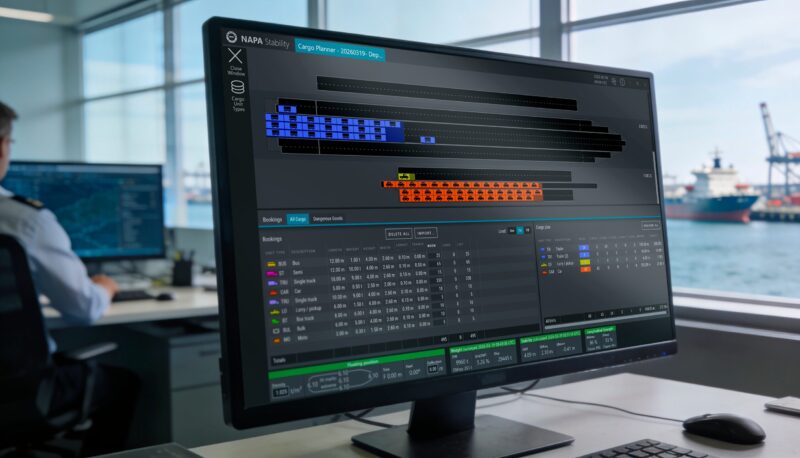
Together, these are the basis of NAPA Stability for RoRo, a stability and cargo planning solution co-developed with Stena Line and in trial on the Gothenburg to Kiel route. It combines cargo planning and stability calculations into a single workflow, with a drag-and-drop planner that shows the impact of every loading decision on stability in real time.
Captain Jörgen Gustavsson of the Stena Germanica put the change plainly: “What used to take an officer about 1 to 1.5 hours now takes 10 to 15 minutes.” (Read the Stena Line case). That time goes back into the operation, where it is needed most.
The bigger picture: admin burden beyond the bridge
AI Cargo planning is one of many features. Seafarers perceive they spend around 20% of their working hours on administrative tasks that add little value. As environmental and compliance reporting grows, that load grows with it. Every hour on paperwork is an hour away from the operation.
This is why cargo planning sits inside a wider set of digital operations tools, built to work as one system rather than separate applications:
- NAPA Logbook automates entries from onboard systems, validates them, and keeps audit-ready records, with approvals from more than 20 flag states. Some of our customers have documented around 2,000 admin hours saved per vessel per year after digitalizing its logbooks. Ferry operators, including Finnlines, Color Line, and Isle of Man Steam Packet Company, have moved to NAPA Logbook.
- NAPA Permit to Work replaces paper permits, removes the chase for signatures and gives ship and shore real-time visibility of what work is happening where.
- NAPA Checklist brings guided, standardized workflows for arrival, departure, and watch handover.
- NAPA Fleet Intelligence connects this to shore: stability status, logbook records, compliance data, and permits in one view, without calls to the bridge or waiting for reports.
The point is the connection. Stability data feeds the logbook. The logbook validates against the same onboard sensors. Checklists tie into the same workflow. NAPA is not another disconnected tool on the bridge. It is one data layer across the operation, from the car deck to the bridge to the office ashore.
The takeaway
For RoRo and RoPax operators, the next gains in efficiency will not come from a faster loading computer alone. They will come from connecting the data officers and shore teams already produce, so that planning, compliance, and oversight stop being separate manual jobs. The hour saved on cargo planning is the first visible proof. The larger opportunity is an operation that runs on one connected layer of data.
FAQs
- What is NAPA Stability for RoRo? NAPA Stability for RoRo is a stability and cargo-planning solution designed for RoRo and RoPax operations. It combines cargo planning and stability calculations into a single workflow, with booking system integration, automated IMDG dangerous goods handling, and AI-assisted loading. NAPA has co-developed this with Stena Line.
- How long does cargo planning take on a RoPax vessel? On some vessels, manual cargo planning and dangerous goods entry took 1 to 1.5 hours per departure. Stena Line officers using NAPA Stability for RoRo report that the same work now takes 10-15 minutes.
- How does the system segregate IMDG dangerous goods? The system imports dangerous goods units automatically with their IMDG classification details and applies the IMDG Code’s segregation rules. This replaces manual, unit-by-unit entry.
- Does AI replace the officer in cargo loading? No. The system proposes a loading plan based on historical conditions and crew preferences. But the officer remains in control and can switch between automatic and manual modes or adjust the plan.
See how NAPA delivers value for RoRo and RoPax fleets
Explore how NAPA helps Ferry and RoPax fleets improve efficiency, support compliance, and advance sustainability with connected ship safety and efficiency solutions.