August 9, 2026
Debunking 7 maritime decarbonization myths: what shipowners get wrong about routing, fuels and WAPS

The maritime industry is navigating one of the most complex operating environments it has ever faced. Tightening regulations, commercial pressure, and expectations around efficiency are all converging at once. As these challenges continue to be discussed far and wide, myths and misconceptions can arise. In this environment, believing myths can be expensive too. They can delay decisions, discourage investment, and prevent shipowners and operators from using proven tools that improve performance across the fleet.
In this part two of our ‘myth-busting’ blog, we are helping the industry navigate these decarbonization challenges, cutting through uncertainty with clarity. From FuelEU Maritime and fleet renewal strategies to voyage optimization and wind-assisted propulsion technology, there are clear areas where practical technology, actionable data, and the right operational strategy can optimize performance and deliver value today.
* In part one, we tackled 7 common myths about maritime digitalization – from what data can realistically deliver to what it takes to put it to work on board.

Ossi Mettälä
Product Manager
Shipping Solutions, NAPA
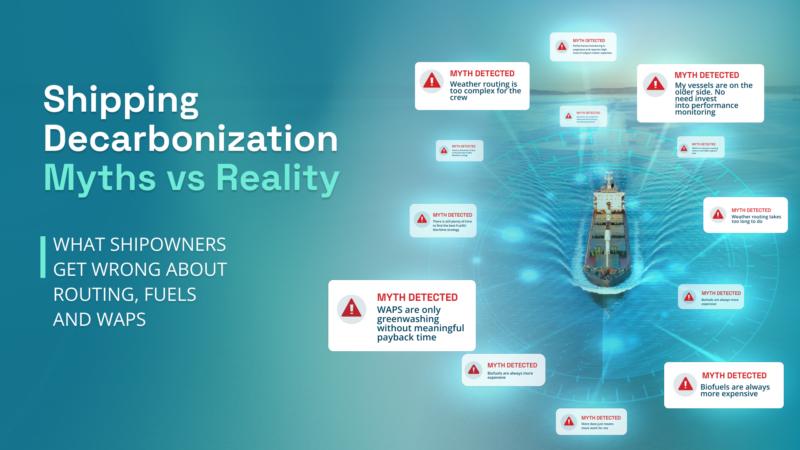
1. “Weather routing is too complex for the crew”
If weather routing requires PhD-level expertise, then the tool has failed its purpose. Modern routing tools are designed to be approachable and practical to use. They automatically combine the information that matters, including reliable weather forecasts, routing logic, vessel performance models, and operational limitations, into one platform. The aim is not to create more work for the crew, but to support them with clearer, faster, and better-informed decisions.
At NAPA, we believe technology should strengthen operations on board, not complicate them, and we work with seafarers across the maritime industry to ensure our digital tools are delivering what they need. If a routing solution is doing its job properly, it will help crews act with confidence and improve both safety and efficiency in the process.
2. “Weather routing takes too long to do“
Traditionally, weather routing was often outsourced because it was seen as too time-consuming and too complex to manage on board. That is no longer the case. With modern routing tools, the crew can access timely weather forecasts and run route optimization in a matter of minutes, while still taking into account routing restrictions and safety requirements.
What once took a long manual process can now be done quickly and with much greater consistency. Manual plotting on a chart takes time. Algorithmic optimization takes seconds. The question is no longer whether there is time to route, but whether operators can afford the inefficiency and wasted fuel that come from not optimizing the voyage.
3. “I don’t need weather routing in my operations“
This is a common misconception or assumption, especially on short-sea trades or fixed routes, but it overlooks how much weather and sea conditions still affect safety, timing, and fuel efficiency. Even on repeat voyages, routing can help seafarers respond better to changing conditions and make small operational adjustments that add up over time.
On deep-sea voyages, the value becomes even clearer, as the exposure to changing conditions is greater and so is the opportunity to optimize. Weather routing is not only for unusual voyages or difficult conditions. It is a practical way to improve daily operations, strengthen safety, and build more efficient trading patterns.
4. “There is still plenty of time to find the best FuelEU Maritime strategy”
Waiting until the penalties hit is the most expensive way to navigate FuelEU Maritime, and we are now firmly in the implementation phase of this regulation. Plus, the compliance trajectories will only tighten over time. Penalties are also robustly enforced and, at €2,400 per ton VLSFO energy equivalent, they are high enough to encourage investment in alternative green fuels.
Achieving over-compliance today, meanwhile, unlocks commercial benefits via banking and pooling mechanisms. Banking allows companies to carry surplus compliance over to the next years and pooling allows them to group ships’ balances, so the pool results offset individual deficits or surpluses. Whether a company decides to bank, borrow, or pool, the decision is easier and more effective the earlier it is made.
The choices made today will shape the profitability of tomorrow and delaying them reduces flexibility at exactly the time when operators need it most. FuelEU Maritime should not be treated as a last-minute compliance problem. It is a commercial and operational strategy question. Companies that act early will be in a much stronger position than those forced to react under pressure.
5. “WAPS are only greenwashing without meaningful payback time“
Wind-assisted propulsion systems (WAPS) are increasingly mature and have moved far beyond the experimental or even pilot phase. Validated fuel savings are already being seen, with results depending heavily on the selected technology, the amount of systems installed, and the operating conditions of the vessel. To reach their full decarbonization potential, WAPS must be paired with voyage optimization technology. Weather routing, for example, can capture the most favorable wind conditions, maximizing fuel savings and making the return on investment (ROI) very attractive.
What matters is evaluating the investment opportunity strategically. The payback period should be calculated before installation based on the vessel’s design and intended operations; it is vital to recognize that each ship has a unique operational profile, so the ROI calculated for one will not necessarily apply to another. The savings should then also be independently verified after installation before scaling to the rest of the fleet. With the right analysis and application, WAPS are not a hypothetical solution but rather a tangible way of achieving fuel savings, greenhouse gas (GHG) and local emissions reductions today.
6. “Biofuels are always more expensive“
It is true that the spot price of biofuels compared with conventional fossil fuels is higher, and this is true of all alternative marine fuels. However, that misses the bigger picture. The option to use biofuels gives ship operators more flexibility, building resilience against energy price spikes, which is increasingly important given today’s geopolitical uncertainty.
Secondly, the total cost of ownership, and especially factoring in the costs of compliance, is more important than bunker price alone. This is particularly true of ships operating within or into the European Union. Once EU Emissions Trading System (EU ETS) savings and FuelEU Maritime penalties are considered, the option that first appears more expensive can often become commercially viable.
Essentially, in a changing regulatory environment, looking only at headline fuel cost can lead to the wrong conclusion. Decisions should be based on the wider commercial reality.
7. “My vessels are on the older side, so there’s no need to invest in performance monitoring“
In fact, older tonnage may need performance monitoring and optimization even more than newer vessels. Older ships are under the same regulatory pressure as the rest of the fleet, including frameworks such as the International Maritime Organization (IMO) Carbon Intensity Indicator (CII) and FuelEU Maritime. Improving how those vessels operate is often a more cost-effective option than relying only on expensive retrofits, alternative fuels, or early vessel replacement.
Performance monitoring helps operators and owners understand where efficiency is being lost and where action can still make a meaningful difference. Monitoring alone is not enough either. At NAPA, our approach has always been to help operators turn data into insights and action. There may be simple ‘low-hanging fruit’ that companies can pick for their existing ships to remain competitive and compliant for longer. Rather than less attention, older vessels actually need even smarter decision-making to balance investment with performance. With the right framework, these ships can still become more efficient, reduce compliance exposure, and maintain asset value for an extended period.
To summarize, the maritime industry does not need more noise around digitalization, decarbonization, and performance. It needs practical thinking, reliable tools, and a clear understanding of what actually delivers return on investment.
Want to know more?
Get in touch with our experts to know how to boost efficiency to improve competitiveness
See how optimization delivers savings in practice
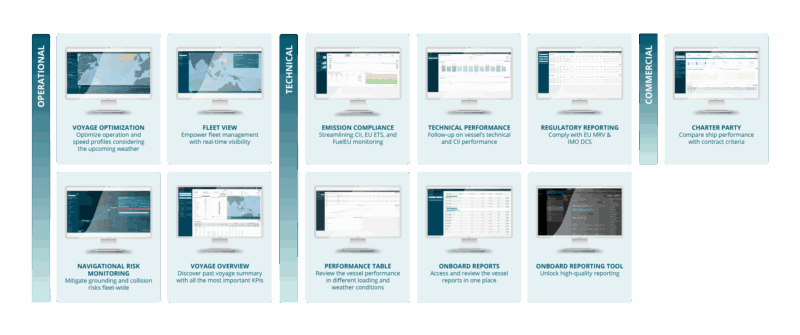
Debunking myths is an important first step, but savings come from applying the right tools voyage by voyage. With weather routing, performance monitoring, and compliance data working together, shipowners and operators can cut fuel consumption, meet FuelEU Maritime and CII requirements, and make confident investment decisions on WAPS and alternative fuels.
Explore how NAPA helps fleets optimize every voyage, verify savings, and turn compliance into commercial advantage.
Explore:
- How to optimize every voyage for fuel savings, safety, and schedule reliability
- How to turn FuelEU Maritime compliance into a commercial advantage through banking and pooling
- How to verify WAPS savings and keep older tonnage competitive for longer