December 11, 2025
Beating the carbon bill: voyage optimization and wind propulsion

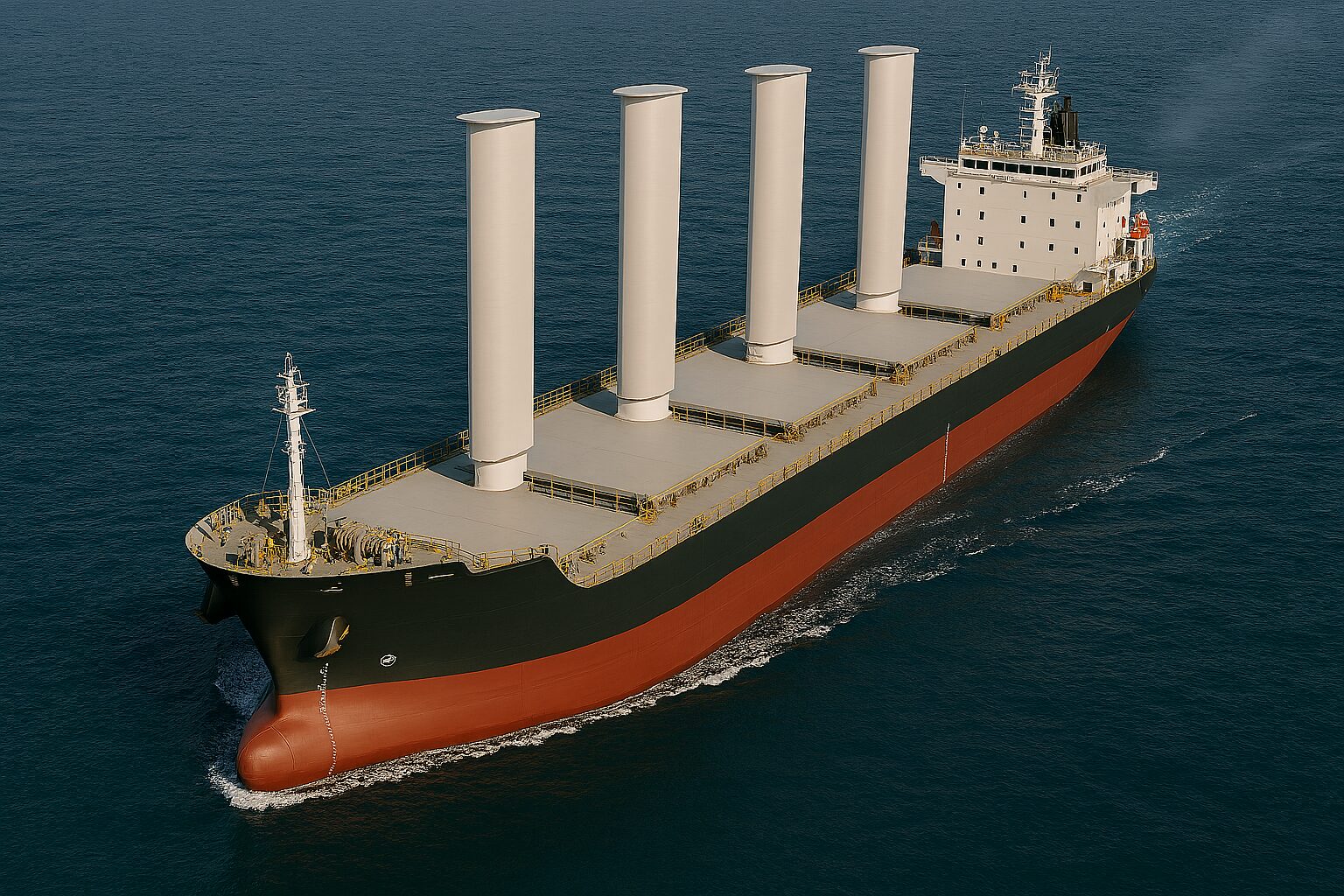
Market based emissions regulations are rapidly evolving from policy discussions to real financial consequences for shipping companies. As these costs become impossible to ignore, operators are reassessing how to run their vessels more efficiently. Among the solutions gaining momentum, two stand out for their impact – and for how effectively they work together: voyage optimization and wind-assisted propulsion.
Wind propulsion adoption: market trends & forecasts
According to the International Windship association (IWSA), with installations growing year-on-year, there will be 100 ships with wind propulsion technologies installed by the end of January 2026. The IWSA also cites projections from the UK government that 40-45% of the fleet (over 40,000 vessels) will feature this technology by 2050 and more ambitious predictions from the EU that over 10,700 wind systems will be installed by 2030.
According to Gavin Allwright, Secretary General of IWSA, the wind propulsion market is nearing a perfect storm that will further drive demand. There is a growing recognition of the sustainability potential, a reduction in prices, a critical mass of technology providers, an improved perception of technology performance, and favorable current and future regulatory policy.
In a panel discussion at the IWSA London International Shipping Week 2025 Wind Propulsion Session, speakers recognized that voyage optimization technology is vital to these wind systems achieving their full decarbonization potential. As well as optimizing routes to harness the trade winds, advanced voyage optimization technology, specifically designed for wind propulsion, plays a central role in verifying and validating efficiency performance for ship operators and regulators alike.
How emissions regulations are reshaping shipping costs
Shipping companies that can effectively navigate this new maze of emissions regulations will gain a significant cost-based competitive advantage. A typical example is those who can minimize their costs within the EU Emissions Trading System (EU ETS).
Drewry researchers, using an EU allowance (EUA) price of $70, expect the EU ETS to have cost shipping companies approximately $2.9 billion at the first surrender deadline – which was the 30th of September 2025 – when 40% of 2024 CO2 emissions are in scope. This will rise to $7.5 billion once 100% of CO₂ emissions, alongside methane and nitrous oxide, are covered.
In parallel, FuelEU Maritime has teeth and is already starting to bite bottom lines. Penalties are robustly enforced and, at €2,400 per ton VLSFO energy equivalent, they are high enough to encourage investment in alternative green fuels. This can, in turn, increase demand for efficiency technologies.
Green fuels will no doubt play a vital role in shipping’s energy transition, but the inconvenient truth is that they are less energy-dense, or calorific than existing oil-based fuels, as well as currently being more expensive and scarcer. This leaves ship operators with three options: bunker more frequently and incur additional port fees; carry more fuel, thereby reducing revenue-generating cargo-carrying capacity; or invest in technologies that reduce fuel use.
FuelEU Maritime also features an interesting wind reward factor. Essentially, ships with WAPS gain improved annual average ratings for the GHG intensity of energy used onboard. This improvement can go up to 5%, depending on the ratio between the effective wind power and the installed propulsion power of the ship.
The IMO Net-Zero Framework (NZF) is essentially a combined fuel standard and emissions pricing mechanism, so the impact would be similar to EU ETS and FuelEU Maritime – but on a global scale. The NZF also has higher emissions reduction requirements after 2028, further enhancing its influence. However, there is still much uncertainty around the impact of the NZF and schedule of adoption of the regulations, especially since the framework was delayed by a minimum of one year in October 2025 after IMO member states couldn’t agree on formal adoption.
Why wind-assisted propulsion must be paired with voyage optimization

Analyzing these regulations in combination, it is clear that navigating them well will require efficiency technologies. And one of the most effective ways to do that is through voyage optimization. NAPA Voyage Optimization goes well beyond just weather routing. It also optimizes the ship’s speed profile for each voyage, enhances data-sharing from ship-to-shore, and supports just-in-time arrivals– saving ship operators even more fuel, and money.
Our voyage optimization system supports and enhances the performance of different wind propulsion technologies. For example, kites, rigid wings, suction and rotor sails can already be modelled in NAPA voyage optimization. It is widely recognized that these technologies must go hand in hand with voyage optimization systems. Essentially, harnessing wind power is as much about weather routing and voyage optimization as it is about the physical sails.
The complexity of routing wind-assisted vessels is much higher than for ships propelled by conventional engines only, given the vast range of variables that must be considered. Changing wind speed and direction, as well as waves and currents, must be assessed (and constantly reassessed) throughout the voyage to determine the best possible route.
At NAPA, we have risen to this challenge, helping ship operators harness the full fuel and emissions-saving potential of the wind. Those relying on traditional means and manual methods will leave a lot of savings on the table, meanwhile NAPA Voyage Optimization enables crews to simulate and evaluate different routes and speed profiles and adapt the ship’s course to make the most of wind patterns.
The potential of digital technology to act as a catalyst for wind power goes beyond fuel savings. Going forward, data analysis and simulation tools will further enhance the safety and stability of wind-assisted ships, especially as sails become larger and more complex. These advanced simulation and 3D modelling tools can also support shipowners’ decision-making in the design phase – helping them choose the right efficiency solution for their ship and its unique operating profile, as well as projecting realistic emissions-saving performance for specific voyages.
How NAPA unlocks the full value of wind-assisted propulsion
NAPA has conducted several simulations showcasing the combined potential of voyage optimization software and WAPS. For example, a joint study led by NAPA, Sumitomo and Norsepower has shown that combining rotor sails and voyage optimization can achieve average emissions reductions of up to 28%, with 12% attributable to weather routing.
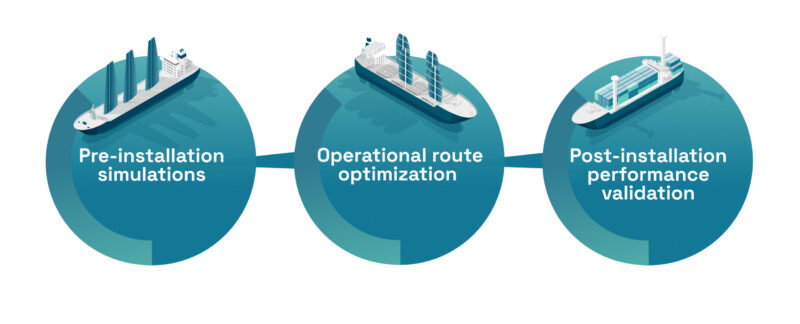
Central to these calculations is NAPA’s industry-leading performance model, which combines decades of naval architecture expertise from NAPA ship design heritage with real-world onboard data to deliver reliable, accurate results. The model captures not only propulsion efficiency but also the lateral forces and stability effects of different wind systems – ensuring every simulation reflects true vessel performance. This allows shipowners to quantify the value of WAPS investments with confidence, whether it’s pre-installation simulations, operational route optimization, or post-installation performance validation.
The bottom line is that as environmental regulations expand and compliance costs rise, more shipowners are recognizing that combining WAPS with advanced voyage optimization delivers one of the most powerful levers for reducing fuel consumption, emissions, and operational costs. With NAPA Voyage Optimization built on the unique NAPA Performance Model, operators gain not only route guidance but a data-validated understanding of vessel behavior. This enables smarter investment decisions, higher savings, and stronger regulatory performance. Those who embrace this combined approach will be better positioned to stay ahead of both competitors and compliance pressures.
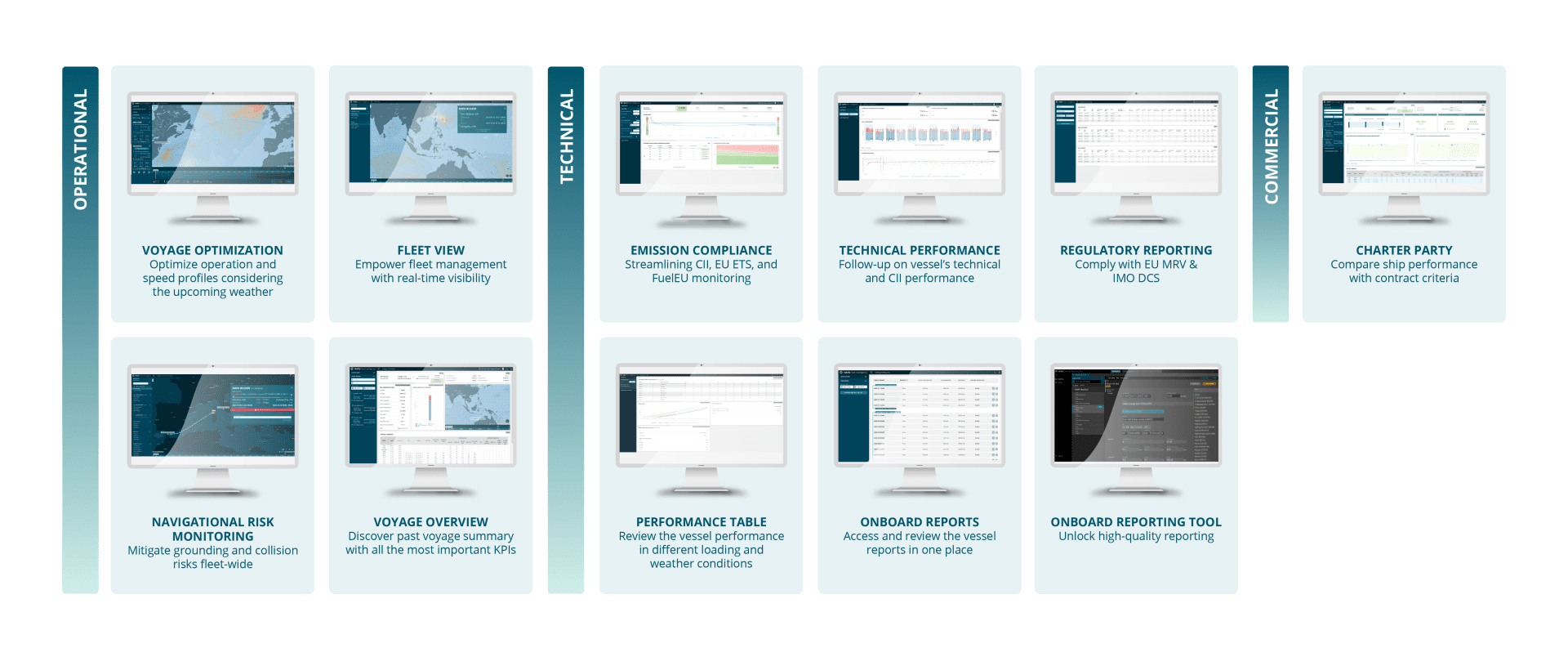
NAPA Fleet Intelligence for smarter, safer, and more sustainable shipping
Want to know more?
Get in touch with our experts to know how to boost operational efficiency to improve competitiveness