June 26, 2026
Four challenges defining ship design today — inside the NAPA User Meeting 2026

Shipbuilding is now a strategic government priority, and AI is changing the game. At this year’s NAPA User Meeting, the industry reunited to turn this momentum into vital collaboration. We discussed how NAPA design software is purpose-built to help ship designers and engineers meet four of the challenges defining the industry today: growing complexity, disconnection, the skills shortage, and maritime decarbonization.
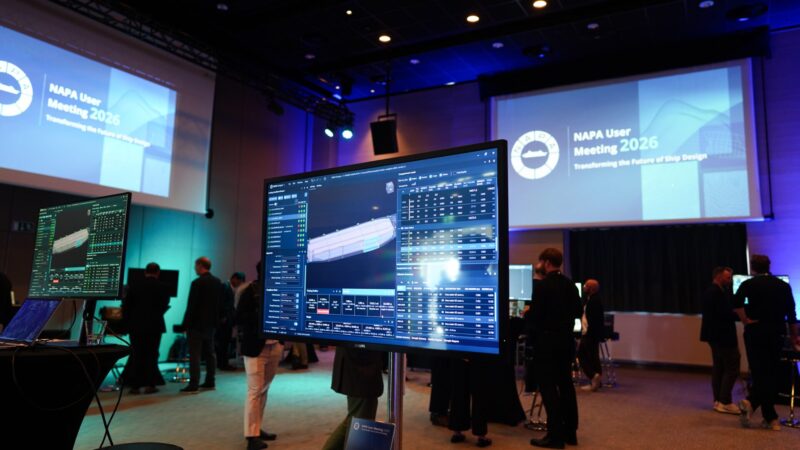
The NAPA User Meeting 2026 has drawn to a close in Helsinki, and over 100 experts from 20 countries and 57 companies – including shipyards, designers, class societies, and academia – gathered again this year to share their ideas and passion, as well as examples of how NAPA solves real-world ship design challenges. We would like to thank all attendees and our guest presenters, including Hanwha Ocean, Rauma Marine Constructions, Nevesbu, Helsinki Shipyard, Chantiers de l’Atlantique, and Lloyd’s Register.
The industry moment: Shipbuilding as a strategic government priority
To set the scene, in June 2026 the global vessel orderbook is at a 17-year high, having reached 191 million by compensated gross tonnage (CGT), equivalent to 17% of the existing fleet. This highlights an exciting opportunity for ship designers, but it also brings major challenges.
There has been a clear change in how governments see the shipping and shipbuilding sectors. Our industries are now front-page news, and strategic investments are increasing with economic growth, national security and supply chain resilience in mind.

Japan has announced its Shipbuilding Industry Revitalization Roadmap, with an ambitious target to double shipbuilding output by 2035, backed by substantial public and private investment. The European Commission launched its first-ever Industrial Maritime Strategy, framing shipbuilding explicitly as a matter of technological sovereignty. And the United States announced the Maritime Action Plan earlier this year, described as the most ambitious commitment to revitalizing the U.S. maritime industry since the 1930s.
These are three major economies, with three significant maritime policy commitments, all announced within the past six months. It is clear that shipbuilding has become a strategic priority for governments, marking a major change from this time last year.
NAPA’s response: purpose-built for the shipbuilding challenges
With record orderbooks and historic investments, the outlook for shipbuilding is optimistic – but opportunity and pressure often arrive together. Ship design today faces four challenges that demand attention: growing complexity, disconnection, the skills shortage, and maritime decarbonization. Each challenge is significant on its own, and together they are defining what must be overcome to stay competitive.
The challenges are real, and so the response has to match them. NAPA’s response is a comprehensive set of discipline-specific yet interoperable design tools that form part of a consistent digital ecosystem. At the User Meeting, we looked at how NAPA solutions address each challenge, turning complexity into clarity, disconnection into integration, the skills shortage into productivity — and realizing fit-for-purpose designs for real operating conditions as the cost of emissions rises.
1. From complexity to clarity
The complexity of our industry is at new heights, largely driven by designs that push the boundaries of engineering, evolving regulations, and the inherently multidisciplinary nature of ship design – where stability, structures and performance must all be balanced simultaneously.
The goal of NAPA’s design tools is to turn that complexity into clarity: to let naval architects make better decisions earlier, with confidence. At the User Meeting, NAPA’s Olli Puustinen, Director of Product Management; Jan Furustam, Director of Business Development; and Thijs Muller, Lead Application Analyst & Marine Advisor, showcased how NAPA optimizes the integrated ship design experience, cuts through complexity and allows users to make better design decisions earlier.
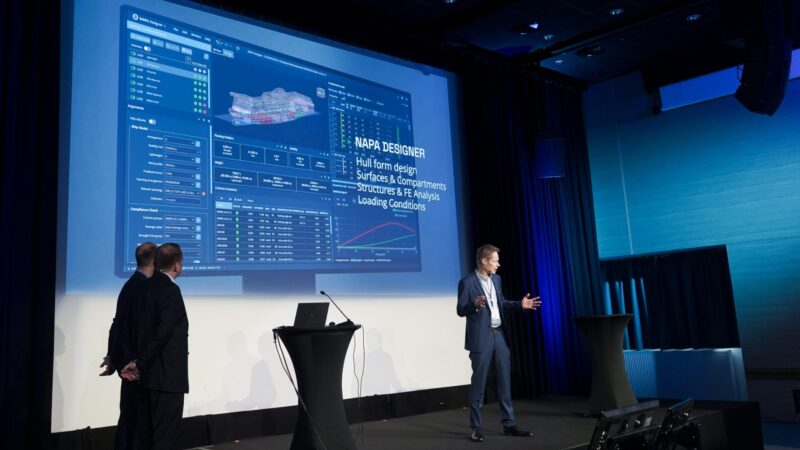
They highlighted how everything starts from the software. NAPA’s trusted calculation engine is the foundation, and calculations are regularly renewed to enhance reliability and analysis. The user interface, use of operational data, and optimization tools, then build up the next layers. Finally, the newest addition is AI productivity and design tools, which the NAPA team argued will change the shipbuilding industry sooner than many people think.
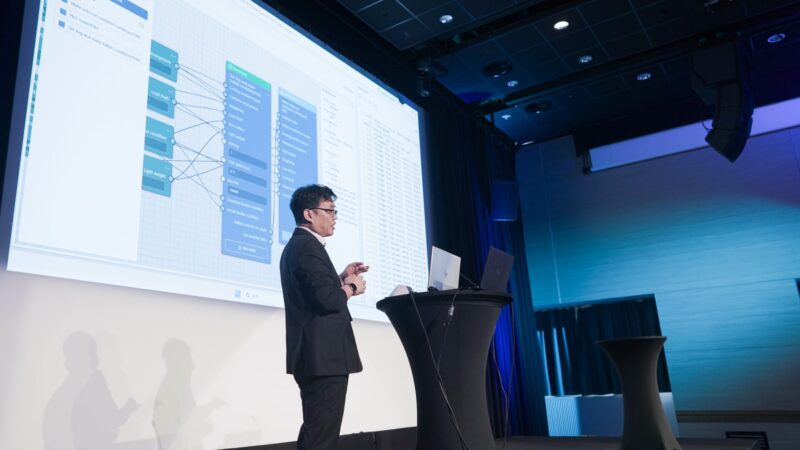
During the event, we heard about the latest developments in NAPA Designer and NAPA Engineer, and saw real examples of how both simplify the work of naval architects. NAPA Designer provides a 3D environment optimized for fast, interactive ship design — from hull form and ship models to loading conditions and intact stability calculations, it has everything needed to get from concept to a compliant design quickly. NAPA Engineer takes that foundation further, making multidisciplinary design more manageable. At its heart is the Node Network, which gives a visual representation of tasks and dependencies by structuring them into clear, manageable workflows; because changes propagate automatically across disciplines, teams get more iteration cycles in less time despite the complexity.
2. From disconnection to integration
Disconnected design phases, manual data re-entry, and compliance checking outside the design workflow mean less time for real design iteration and risk costly errors downstream. This disconnection is an especially prevalent challenge in structural design.
NAPA Steel is purpose-built for solving this challenge in ship structural design. Above all, this means a single 3D model is used from basic to detail design phases, where key decisions affecting structural integrity and construction strategy are made.
Connecting prescriptive and direct structural assessment within this single model enables quicker design iterations and faster class compliance assessment. The rich 3D data produced in NAPA Steel is reusable in hull production and outfitting design, and accessible to all stakeholders. This reduces rework, supports design revision, and avoids costly errors at later stages.
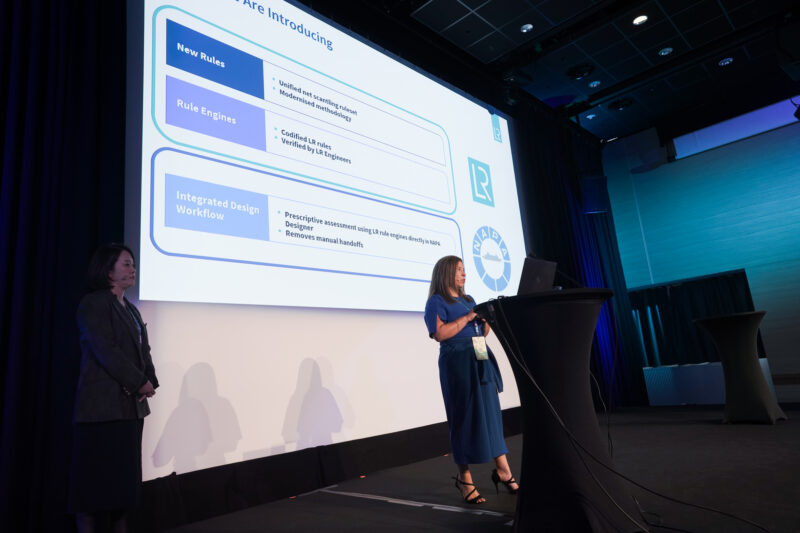

Class society approvals can also add to the challenge. Typically, design decisions are made early, but compliance feedback can come late. Iterations between design and class slow down progress, and multiple tools and handoffs increase design time and risk. At the User Meeting, we saw how Lloyd’s Register and NAPA are already collaborating to tackle this challenge.
Catriona Hall, Product Owner, and Seon-Ae Lee, Product Manager, from Lloyd’s Register, outlined how it is modernizing its structural classification framework through a unified net scantling rule set and an integrated digital workflow built around NAPA’s 3D design environment. Emma Fischer, Software Team Manager, Lloyd’s Register, and Kristoffer Brink, Product Owner, NAPA, explained how LR’s next-generation rule engines, covering prescriptive assessment, will operate directly inside NAPA Designer. Essentially, compliance becomes part of the design process, evolving together in the same environment, to streamline early-stage hull design and plan approval.
3. From skills shortage to productivity with AI
While it is positive that the market is demanding more ships, the expert pool hasn’t grown with the demand. Naval architecture takes years to master, and domain expertise cannot be built overnight. When it comes to core know-how of ship design, the skills shortage is real.
NAPA’s advantage has always been the flexible tools that can be configured according to the need. Those who have combined domain expertise and process knowledge with NAPA’s customizability have been able to multiply their output far beyond conventional methods. This is a real advantage, but the barrier has been a steep learning curve. That barrier is now coming down.
At the User Meeting, we showcased how NAPA’s solutions and emerging AI-powered tools can increase the productivity of naval architects. Haseeb Shehzad, Senior Software Developer, and Hanmin Lee, Senior Technical Consultant, conducted a workshop with NAPA Steel users on AI-assisted C# scripting for structural design in NAPA Designer.

Lari Haapaniemi, Software Developer, and Jaakko Carlstedt, Senior Software Developer, showed how NAPA is deploying an integrated AI Productivity Tool. This can accelerate users’ productivity, for example, by explaining NAPA concepts and using them to ease the creation of automated workflows and tools, turning natural language into macros and scripts, and leveraging existing designs and data – all integrated directly into NAPA Designer and NAPA Engineer.
4. Future-proof designs for real conditions
Last but not least, maritime decarbonization is reshaping the commercial benchmark, with shipowners increasingly expecting real sea performance data rather than only a guaranteed service speed to accurately assess carbon costs. To illustrate how this challenge is affecting newbuilding agreements: Earlier this year, Japan Marine United and NYK signed a VLCC contract where actual sea performance in real conditions is the contractual guarantee.
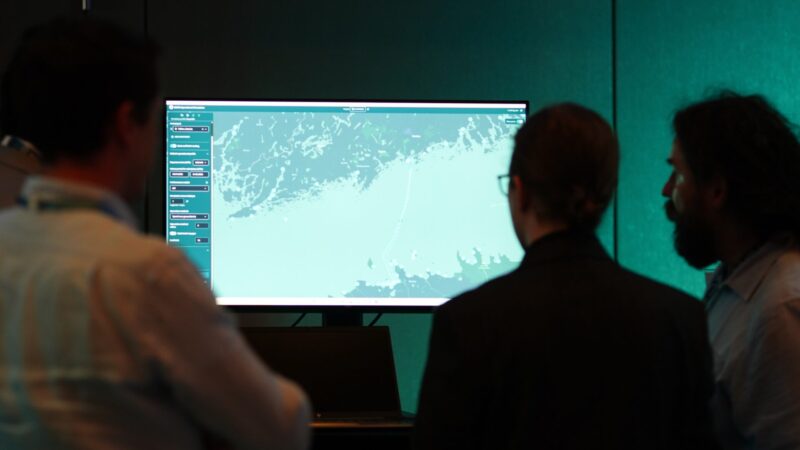
NAPA Operational Simulation is a response to the need for real, at-sea performance data. Users can simulate their design on real routes and weather conditions and get data-backed evidence of how it actually performs, connected directly to the initial design workflow. This supports the creation of future-proof designs and holistic design decisions before any steel is cut.
At the User Meeting, Antti Pösö, Product Owner, together with Haseeb Shehzad, showed how the NAPA Operational Simulation – built on NAPA’s trusted platform— integrates voyage optimization, routing, and weather and environmental data to project-specific fuel and cost savings for a vessel design based on the performance model.



Transforming the future – together
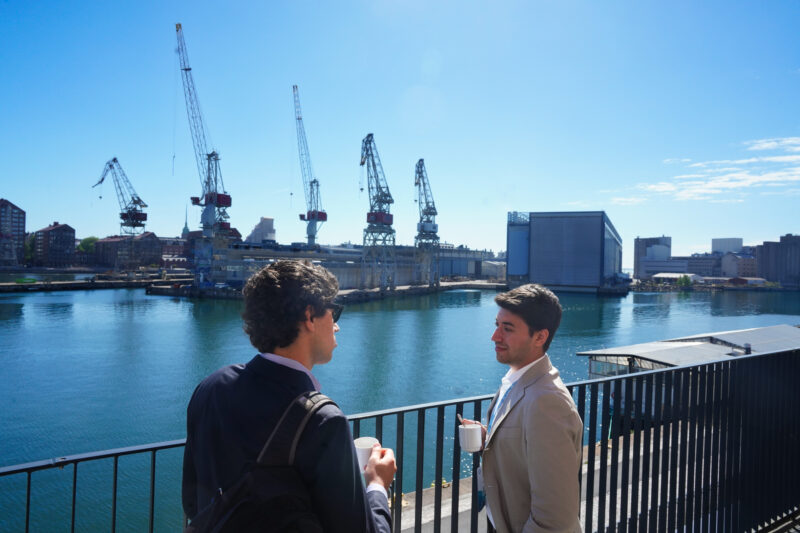
To rise to demand from record orderbooks, shipbuilding as a strategic priority, and unprecedented investments, the industry must streamline ship design processes and reduce phase cycle times. Achieving this agility requires seamless collaboration, and we saw this open and constructive mindset in abundance at the NAPA User Meeting 2026.
This need for collaboration is exactly why events like the NAPA User Meeting matter. No single company can navigate today’s challenges alone, and the event remains a rare space where shipyards, design offices, classification societies and academia share how they are solving real problems, shape what we build next, and build relationships that carry well beyond the event itself.
As we continue to design and build the largest man-made objects that move, thank you for shaping the future of ship design with us.