May 6, 2026
NAPA launches stability management solution for RoRo vessels in collaboration with Stena Line
NAPA Stability for RoRo integrates cargo planning and stability management into a single workflow, reducing officer planning time from up to 1.5 hours to approximately 10 minutes per departure.
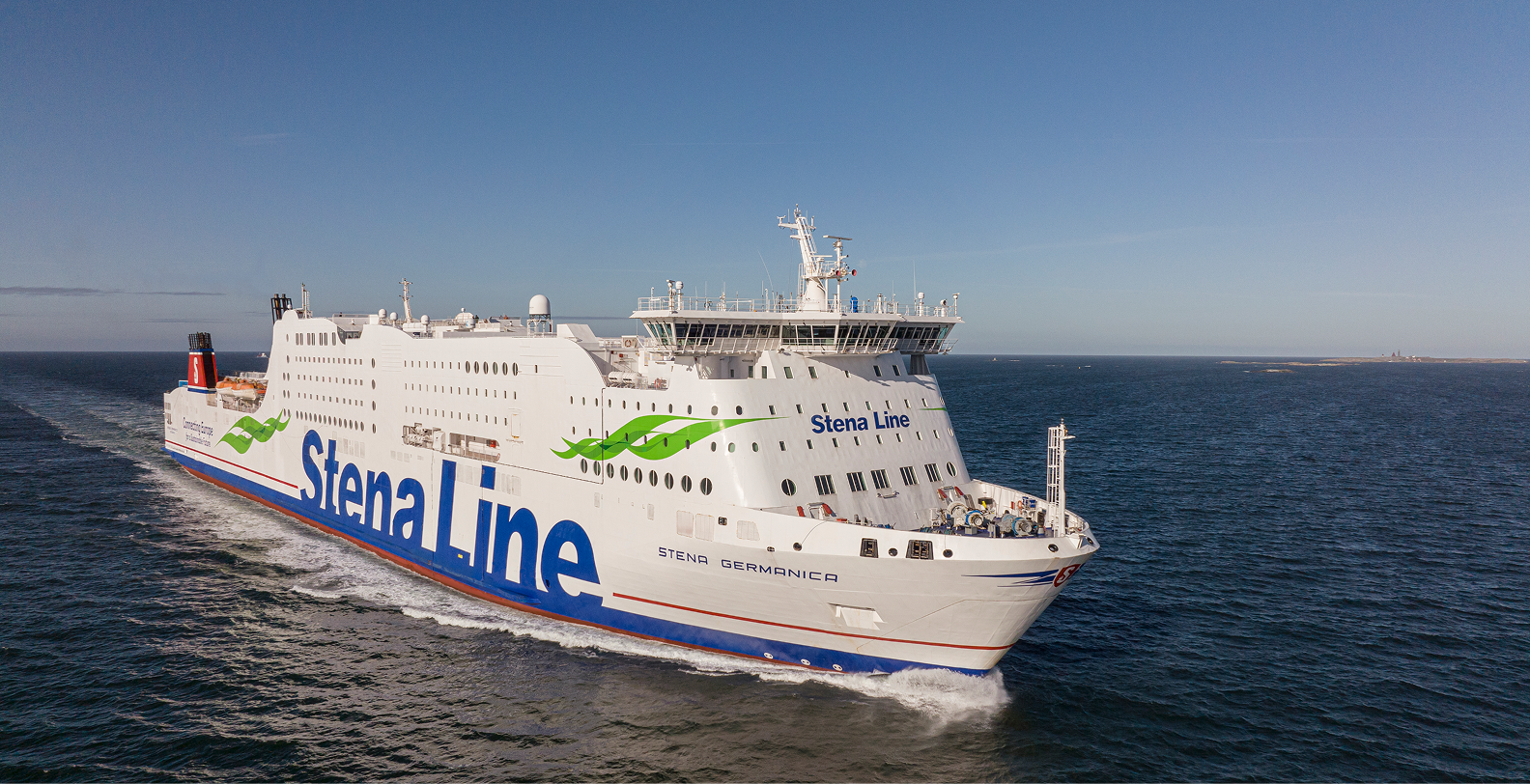
Helsinki, Finland: NAPA, the global provider of maritime software and data services, has launched NAPA Stability for RoRo, a stability management and cargo planning solution built specifically for the operational demands of RoRo and RoPax vessels. The product has been co-developed with Stena Line, one of the world’s largest ferry and RoRo operators, with whom NAPA has collaborated for over two decades on safety and efficiency solutions. The solution is currently in trial deployment on the Gothenburg–Kiel route. The launch extends NAPA’s stability platform, already installed on more than 69 cruise vessels and a growing number of ferry operators, into the RoRo segment with cargo-specific capabilities designed to manage the speed and complexity of short-sea voyage operations.
The launch version of NAPA Stability for RoRo includes AI-assisted cargo loading, which draws on historical loading conditions to propose optimal cargo placement and support better decision-making. Early results from 2025 testing showed encouraging results.
RoRo and RoPax operations present a cargo management challenge unlike almost any other vessel type. A single Stena Line RoPax departure can include up to 1,300 passengers, 90 trailers, 120 trucks, 45 containers, 180 cars, 25 cars with caravans, 30 mobile homes, and 35 dangerous goods units, and in some cases, livestock and rail cargo. Officers must plan cargo placement, verify stability, manage IMDG dangerous goods segregation requirements, and confirm departure conditions within turnaround windows measured in hours with no margin for delay.
Until now, much of this work has been manual and cargo manifests have arrived by email. Dangerous goods data was entered unit by unit into the loading computer. On some vessels, this process consumed 1-1.5 hours of officer time per departure. Existing loading computer systems, while functional, were not designed for the speed, cargo variability, or digital integration demands of modern RoRo operations.
NAPA Stability for RoRo addresses this by connecting directly to the operator’s booking system. Cargo data – including unit types, weights, quantities, and dangerous goods classifications – is imported automatically into the loading computer, eliminating manual transcription from emails and spreadsheets. Officers work from accurate, ready-to-use booking data for every journey, helping save time that can be reinvested into operational oversight and safety decision-making.
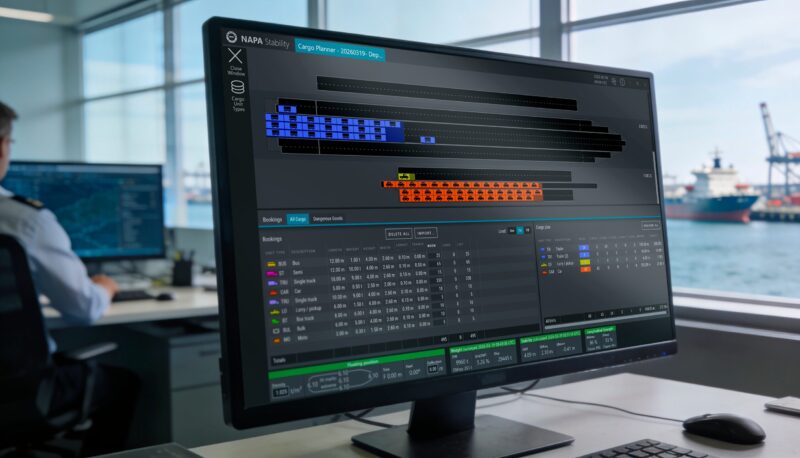
A visual cargo planner in the new solution allows officers to load units onto decks using intuitive, user-friendly drag-and-drop functions, edit areas, and split or move items, while the stability calculation runs in parallel. Officers can see the impact of every loading decision on vessel stability in real time. The system supports both manual and auto mode, giving crews the flexibility to optimize larger cargo batches automatically while retaining full human control over final decisions.
Dangerous goods handling, previously a manual, time-intensive process, is automated within the system. Dangerous goods units are imported with full IMDG classification details, and the system automates segregation in accordance with IMDG Code requirements. This approach also helps minimize errors. Further, NAPA is also developing AI and machine-learning-based rules for the automated placement of dangerous goods, with positive results from ongoing development work.
Capt. Jörgen Gustavsson, Captain, Stena Germanica, Stena Line, commented: “On a RoPax vessel, getting the cargo in the right place is one of the most complex parts of every departure –stability, trim, fuel management, dangerous goods segregation, all under time pressure. With NAPA Stability for RoRo, the manual work is essentially gone. What used to take our officers hours in data entry and planning now takes 10 to 15 minutes. That time goes straight back into the operation, where it matters most.”
David Svanström, Officer, Stena Line, added: “We’ve been working alongside NAPA to build something that fits how RoRo operations actually work. The ability to import accurate booking data directly from our systems into the loading computer –with correct weights and cargo types –means we’re making stability decisions based on real data, not estimates. And the flexibility to switch between manual and auto mode means officers stay in control while the system does the heavy lifting on routine planning.”

Loaded cargo plans, including exact IMDG cargo locations, are shared with NAPA Fleet Intelligence, providing shoreside teams with real-time visibility into vessel loading conditions. This also has direct safety implications: in the event of a fire or other emergency, shoreside teams and emergency responders can immediately see what dangerous goods are onboard and exactly where they are placed on the vessel. The integration supports more effective ship-to-shore communication, both in routine operations and in critical situations.
Emmi Helanne, Product Owner, NAPA Stability and NAPA Emergency Computer, Safety Solutions, NAPA, said: “NAPA Stability for RoRo is designed around a simple principle: the cargo plan and the stability calculation should be one workflow, not two. Officers and crew deal with dozens of cargo types, tight turnarounds, and strict dangerous goods regulations on every sailing. We’ve built a system that imports booking data directly, automates IMDG segregation, and gives officers a real-time view of how every loading decision affects vessel stability. The AI-assisted loading capability takes this further – it learns from historical departures to propose smarter cargo placement. This isn’t about replacing the officer’s expertise. It’s about giving them better tools so they can focus on the decisions that matter.”
Markus Tompuri, Account Director, Ferry and RoRo, Safety Solutions, NAPA, added: “With NAPA Stability now serving cruise, yachts, ferry, and RoRo segments, we’re delivering the industry’s most complete stability management platform for passenger ships. The collaboration with Stena Line has been instrumental – their operational expertise, built over decades of RoRo operations, has shaped every capability in this product. When a Stena Line captain tells us that cargo planning has gone from over an hour to 10 minutes, that’s the kind of measurable impact we’re building for. The RoRo segment has been underserved by digital stability tools for too long, and we’re changing that.”
NOTES TO EDITORS
About Stena Line
Stena Line is one of Europe’s leading ferry companies with approximately 40 vessels and 20 routes in Northern Europe and the Mediterranean, operating 35,000 sailings each year. Stena Line is an important part of the European logistics network and develops new intermodal freight solutions by combining transport by rail, road, and sea. Stena Line also plays an important role in tourism in Europe with its extensive passenger operations. The company is family-owned, was founded in 1962 and is headquartered in Gothenburg. Stena Line has 8,750 employees and an annual turnover of 20.2 billion SEK.
About NAPA
NAPA is a leading provider of software and digital services for the global maritime industry, harnessing data science to enable safer, more sustainable and future-proof shipping. Founded in 1989 to provide smart solutions for ship design, NAPA is now the global reference in shipbuilding, with over 90% of new vessels built by NAPA customers. Today, the company’s expertise spans the entire lifecycle of a ship, from shipyards to operational safety and efficiency at sea. Over 3000 commercial ships globally sail with NAPA safety and efficiency solutions, which include digital ship stability systems that enable a proactive approach to safety at sea, cloud-based performance monitoring that delivers insights to unlock new operational efficiencies, and voyage optimization solutions that help reduce greenhouse gas emissions from voyages.
Headquartered in Finland, NAPA employs 200 experts and operates globally, with a presence in Japan, Korea, China, Singapore, the USA, Germany, Greece, Romania and India. For more information, visit: www.napa.fi
Press contact
Chandralekha Mukerji
Director, Global Communications and PR
T: +358 408273014
E: chandralekha.mukerji@napa.fi
NAPA Stability for RoRo can be your tool for easy cargo planning and efficient compliance
To know how NAPA’s solutions can help you with your ferry and RoRo operations, talk to a NAPA expert.