September 15, 2026
Wind-assisted propulsion is scaling – is voyage planning keeping up?

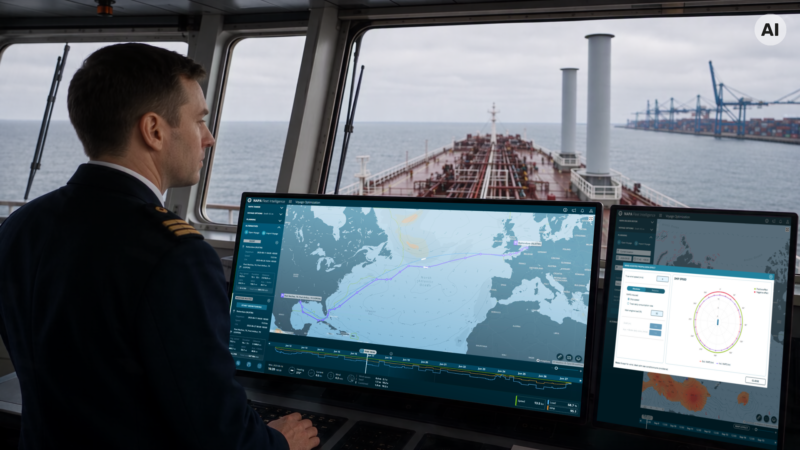
I’ve sat in enough owner meetings over the past year to notice the shift: wind-assisted propulsion isn’t a “someday” technology anymore – it’s a live retrofit decision on the table. The global fleet of commercial vessels equipped with wind-assisted propulsion systems (WAPS) has surpassed 100 ships, with more than 230 individual systems now installed, according to the International Windship Association.
The hardware is proving itself already, with retrofitted WAPS consistently reducing fuel consumption by 5–20% in real-world operation. With regulatory pressure mounting under CII, FuelEU Maritime, and the EU ETS, that kind of performance gain is increasingly difficult to ignore.
But there is a question that tends to get less attention than the technology itself: once WAPS are installed, is the voyage planning workflow actually built to use it? In my experience, for most fleets, the honest answer is; not yet.
Traditionally, the routing problem gets little attention for a conventionally powered vessel, with wind often seen as something to route around; a source of resistance, challenging sea states, and added fuel burn. Voyage optimization has meant finding the path of least resistance while meeting the schedule.
A WAPS-equipped vessel changes that equation completely. Wind is now a source of thrust as well as resistance, and the system’s contribution at any given point depends heavily on wind angle relative to the vessel’s heading. The optimal route for a vessel with rotor sails or wingsails may look quite different from the conventional optimum; a longer track to catch a favorable wind speed and angle combination, or a speed reduction to maximize WAPS output, both weighed against the sea state.
Most weather routing tools were not originally designed for this. They assume a fixed performance profile and treat weather as resistance to route around. Where wind-assist is included, it’s usually just a thrust bonus added on top. The harder questions go unanswered: the lateral forces WAPS create, and how wind speed, wind angle, and engine load interact in real sea states. Researchers understand this physics well by now. What’s rare is a planning tool that applies it to your specific vessel. The failure is invisible: the route looks right, the numbers look fine, and a meaningful share of the WAPS savings simply never materializes.
What the planning system actually needs to do
Supporting a WAPS vessel properly requires more than displaying wind data at the current position. The planner needs to see wind conditions at every point along the full planned route, ahead of departure, so routing decisions are based on what the wind will be doing throughout the voyage, not just at one stage.
Wind angle and speed need to be evaluated simultaneously alongside swell, combined wave height, and current, because of how these variables interact with the vessel. A favorable wind angle in heavy seas may deliver less net gain than a less favorable angle in calmer conditions. WAPS speed contribution needs to be visible at each point of the voyage. And savings need to be quantified in dollar terms, not just percentages [1] so operators can understand the financial value of routing decisions before committing.
This is the approach we’ve built NAPA Voyage Optimization around. It shows wind conditions in three ways: at the vessel’s current position [2], at a selected time step using the time slider [3], and – a more recent addition – a compact view [4] of wind conditions at every position along the entire planned route, when the vessel is at that position.
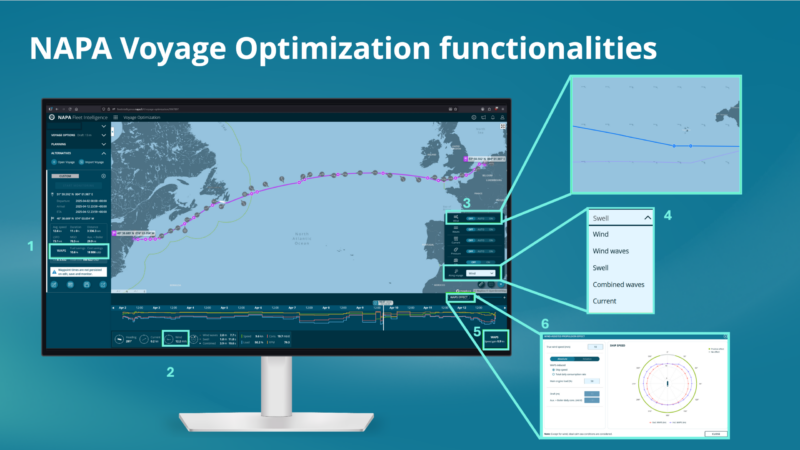
Environmental overlays cover swell, wind waves, combined waves, and current [4]. WAPS speed contribution [5] is visible at any point in the voyage. The polar plot [6] shows how speed and fuel consumption vary across wind angles and engine loads, built on the NAPA Performance Model (3D hull form, hydrodynamics, and real-world operational data) so it reflects how the specific vessel actually behaves, not a generic approximation.
The contract problem needs a data foundation
The commercial challenge is well understood; under time charter arrangements, owners bear the cost of WAPS installation while charterers capture the fuel savings. That split incentive is widely recognized as the primary structural barrier to faster adoption, and it’s why BAR Technologies has spent much of 2026 making the same blunt point in the trade press: the problem is no longer technological, it’s contractual. And with the IMO’s own Net-Zero Framework vote pushed back a year, to October 2026, owners don’t have a global regulatory backstop to lean on in the meantime. The business case for WAPS has to be provable on today’s operational data, not tomorrow’s policy.
But solving the contract problem requires data, and you cannot negotiate how savings are shared if you cannot clearly show what those savings are and where they came from. Without voyage-level attribution that separates WAPS contribution from savings driven by favorable routing or weather conditions, operators have no documented basis for those conversations.
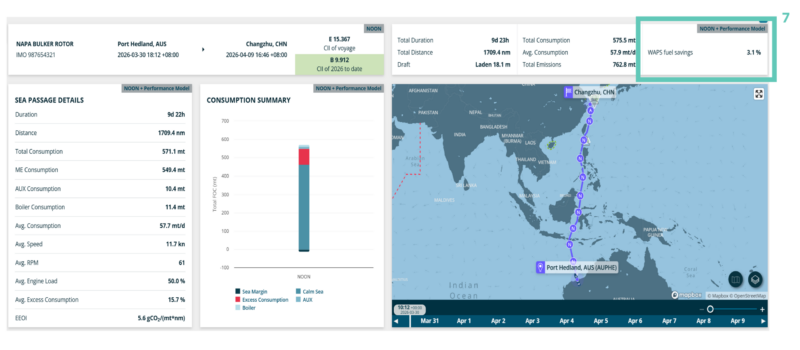
This is where the post-voyage report matters. A formal record [7] of WAPS fuel savings, broken down by voyage, route, and wind conditions is not just a performance monitoring tool, but the evidentiary foundation for any serious discussion about how the value of the system is distributed between owner and charterer. In practice, I’d go further: the voyage planning system is part of the commercial case, not a separate operational concern.
Getting the full return
At its core, wind propulsion works, the regulatory environment is making the case stronger, and the pipeline of installations continues to grow.
And while not every vessel is there yet, the software is catching up. In the fleets I talk to, the operators getting the most out of their WAPS investment are the ones who treated voyage planning as part of that investment from day one – not something they added only after the sails went up. Those are the operators who will be better positioned to capture what the hardware is capable of delivering, and to build the data record needed to navigate the commercial conversations that follow.
The question worth asking, before or shortly after installation is: does your voyage optimization software understand your vessel as it is now, with WAPS installed, or as it was before? That’s the conversation I’d want to have before signing off on any retrofit business case.
Want to talk it through? I’m happy to walk through what this would look like for your specific fleet and routes. Get in touch with our team!